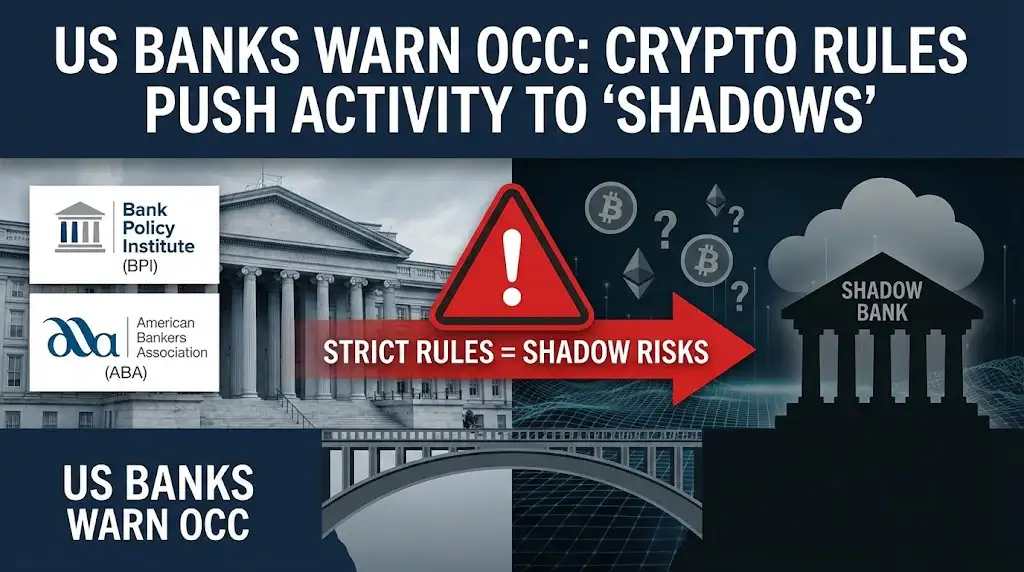
A group of the biggest banking trade groups in the US has sent a strong message to federal regulators: the current rules on cryptocurrency are not keeping the financial system safe; instead, they are putting it at more risk by giving unregulated companies more control over the market.
The Bank Policy Institute (BPI), the American Bankers Association (ABA), and the Securities Industry and Financial Markets Association (SIFMA) all sent a letter to the Office of the Comptroller of the Currency (OCC) saying that the current rules make it impossible for regulated lenders to take part in the digital asset economy.
The Main Point: “Moving to the Shadows”
The banks’ main point of complaint is the idea of regulatory arbitrage. The trade groups say that even though there is still a lot of demand for digital assets, U.S. regulators’ strict capital requirements make it impossible for federally chartered banks to offer crypto custody or trading services.
So, this demand doesn’t go away; it moves to what banks call “shadow banking.” This includes non-bank entities, offshore exchanges, and stablecoin issuers that don’t have the capital buffers, compliance standards, and oversight of regular banks.
The coalition said in the letter that the OCC is unintentionally creating a market structure dominated by shady players by ignoring regulated banks. This makes fraud, cyber theft, and market contagion more likely, like the collapses that have happened in the past.
The “1250% Risk Weight” Barrier
At the heart of the dispute are the capital requirement standards, often referred to as the Basel III endgame implementation.
Under current guidance, banks are frequently required to assign a 1,250% risk weight to crypto asset exposures. This means that for every $100 of Bitcoin a bank holds (even if just for custody on behalf of a client), they must hold $100 of capital in reserve.
- The Industry View: Banks argue this is a “de facto ban,” as it makes crypto custody prohibitively expensive compared to other asset classes like equities or bonds.
- The Regulator View: Regulators have historically maintained that crypto is highly volatile and requires maximum capital insulation to prevent a bank failure from requiring a taxpayer bailout.
Request for a Course Correction
The letter urges the OCC to revise these standards to allow banks to engage with digital assets using “reasonable” risk management frameworks. The banks are specifically requesting:
- Custody Classification: Permission to treat client crypto assets as “off-balance sheet” items (similar to how they treat stocks held for clients), which would remove the heavy capital penalty.
- Stablecoin Integration: Clearer pathways for banks to issue or transact in stablecoins, arguing that regulated banks are better positioned to manage the reserves of these assets than standalone tech companies.
This warning comes at a very important time. Traditional banks think they are missing out on a once-in-a-generation chance to compete with tech-savvy companies because crypto ETFs have just been approved and institutional finance is becoming more integrated (for example, BlackRock’s BUIDL fund and PayPal’s stablecoin expansion).
The letter clearly says that the current approach goes against the administration’s goal of “responsible innovation.” The trade groups say that by keeping the most regulated, compliant, and capitalized institutions on the sidelines, the U.S. is giving up control of the future financial infrastructure to businesses that the OCC does not oversee.
Note: This news was written by our editor, rewritten with the help of AI, and reviewed by our editor to ensure its accuracy and compliance with our standards.